

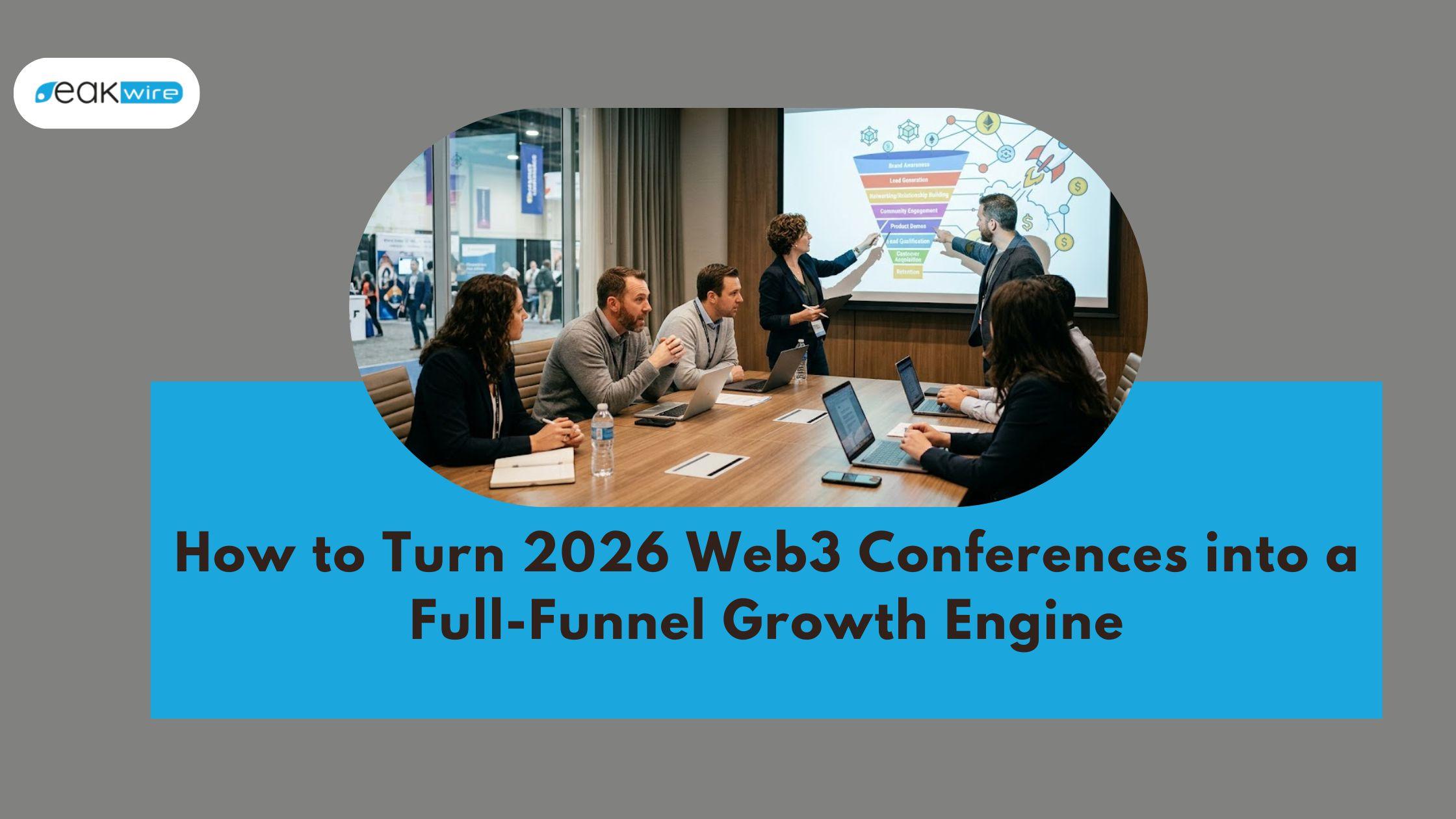
Most projects treat a web3 conferences as an event. Show up, hand out badges, collect business cards, post a few photos on X, fly home. The conference is filed under “marketing spend” and the ROI question goes unanswered until the next budget review.
The projects that consistently generate investor meetings, partnership agreements, press coverage, and measurable community growth from blockchain conferences treat them completely differently. For them, a cryptocurrency conference is not a single event it is a three-phase growth campaign with the conference itself as the activation moment in the middle.
This guide gives you the complete strategic framework: what to do in the six weeks before, the three days during, and the two weeks after any major blockchain event in 2026. It covers lead generation, investor targeting, media strategy, community activation, partnership development, and the specific tactics that turn conference attendance from a cost centre into a measurable growth channel.
Why Web3 Conferences Are Different in 2026
The blockchain and cryptocurrency conference landscape has matured dramatically. In 2026, a web3 conference is no longer a gathering of early adopters exchanging white papers it’s a concentrated ecosystem of decision-makers, institutional capital, protocol builders, and community leaders all occupying the same physical space for 48–72 hours.
That density of intent is extraordinary. You will not find a comparable environment online.
According to industry data, the global blockchain events market continues to grow year-over-year, with flagship blockchain conferences like Consensus, ETHDenver, Token2049, and WebSummit Web3 attracting tens of thousands of verified attendees. Bitcoin conferences such as Bitcoin 2026 have evolved into multi-day growth ecosystems, with dedicated investor tracks, builder summits, and brand activations running in parallel.
The difference between teams that leave these events with a full pipeline and those that leave with a pile of business cards is strategy. Specifically, a full-funnel strategy built around every phase of the conference lifecycle.
That is exactly what this guide delivers.
The Major Web3 Conferences in 2026
Building your conference strategy starts with selecting the right events. Not every cryptocurrency conference serves the same audience or purpose, and attendance without a clear strategic rationale is expensive and unfocused.
| Conference | Location | Primary Focus | Best For |
| Consensus 2026 | Austin, TX (May) | Broad crypto / Web3 | Investors, media, broad ecosystem visibility |
| ETHDenver | Denver, CO (Feb–Mar) | Ethereum / developer ecosystem | Developer partnerships, DeFi, L2 protocols |
| Token2049 | Dubai / Singapore | Asia-Pacific crypto markets | Asian investors, exchanges, regional expansion |
| Bitcoin Conference | Nashville, TN (July) | Bitcoin ecosystem | BTC-adjacent products, institutional audience |
| Permissionless | Brooklyn, NY (Sept) | DeFi, crypto-native builders | DeFi protocols, yield products, crypto-native audience |
| NFT.NYC | New York, NY (Apr) | NFTs, digital art, culture | NFT collections, creator economy, brand partnerships |
| Devconnect | Europe (rotating) | Ethereum development | Developer recruitment, protocol integrations |
| Korea Blockchain Week | Seoul, South Korea | Asian markets, gaming | Korean investor and gaming NFT audience |
| WebSummit Crypto Stage | Lisbon, Portugal (Nov) | Mainstream tech crossover | Enterprise blockchain, mainstream press, EU regulatory |
The Full-Funnel Framework Explained
A full-funnel growth engine maps your conference activity to three core stages:
1. Awareness (Top of Funnel) — Getting your brand, project, or protocol in front of the right audience before and during the event.
2. Consideration (Middle of Funnel) — Turning passive awareness into active interest through content, conversations, and demonstrations.
3. Conversion (Bottom of Funnel) — Closing leads, partnerships, investment conversations, and community commitments in the days and weeks following the event.
Most Web3 teams only operate in stage two — they show up, they talk to people, and then they go home. The teams that win treat every blockchain event as a 30-to-60-day campaign with the event itself at the midpoint, not the endpoint.
Let’s break each phase down.
Before the Event: Pre-Conference Growth Tactics
Vague goals produce vague results. Before any cryptocurrency conference or blockchain event, your team must agree on specific, measurable objectives:
- Lead generation: How many qualified conversations do you need?
- Partnership targets: Which protocols, funds, or platforms are you aiming to meet?
- Investor outreach: Are you raising? What stage, what ticket size, and who are the top 20 firms attending?
- Community growth: Are you targeting developers, retail users, or institutional adopters?
- Press and media: Which crypto journalists and content creators will be there?
Once you have your objectives, every tactic you deploy should trace back to one of them.
Research the Attendee and Speaker Landscape
Most major web3 conferences publish their speaker lists weeks in advance. Use this intelligence. Map speakers to your target categories investor, partner, press, community. Follow them on X (Twitter), engage with their recent posts, and identify shared interests or pain points your project addresses.
LinkedIn is underused in the Web3 space. Many institutional attendees at blockchain conferences maintain active LinkedIn profiles, and a well-crafted pre-event outreach message has a significantly higher response rate than a cold DM on Telegram.
Create Pre-Event Content That Signals Presence
Two to three weeks before a major web3 conference, publish content that signals your attendance and establishes your authority:
- Blog post: “What We’re Looking Forward to at [Conference Name] 2026” — targets the conference keyword, generates organic search traffic, and gives you a content asset to share in outreach.
- Twitter/X thread: Your team’s predictions, the panels you’re most excited about, and what problems you’re actively trying to solve.
- LinkedIn post: A professional, insight-led post about the state of the ecosystem ahead of the event.
- Email to your list: Let your existing community know you’ll be there and invite them to book a meeting.
This pre-event content serves a dual purpose: it builds anticipation with your audience, and it gives prospects at the conference a reason to recognise you before you’ve even introduced yourself.
Book Meetings Before You Arrive
The most valuable meetings at a web3 conference are the ones already in your calendar when you land. Aim to have 40–60% of your target meetings booked before the event begins. Use:
- Grip or Brella (official conference networking apps)
- Direct LinkedIn outreach with a specific, low-friction ask (“I’d love to grab 15 minutes at the event to show you what we’re building”)
- Twitter/X DMs for more informal relationships
- Warm introductions via mutual connections or advisor
During the Event: Converting Attention into Pipeline
At every major blockchain event, the teams generating the most awareness are treating the conference floor like a content studio. Every conversation is a potential short-form video. Every panel is a quote thread. Every happy hour is a candid photo op.
Assign roles within your team:
- One person focused entirely on booked meetings and relationship depth
- One person on organic content capture (video, photos, quotes, live threads)
- One person scanning the floor for unplanned, high-value conversations
If you’re a solo founder at the event, accept that you cannot do all three simultaneously — prioritise booked meetings and document what you can in the margins.
Your Booth and Brand Presence
If you have exhibition space at a blockchain conference, your stand design must do one thing above all else: communicate what you do in under five seconds to someone walking past at speed.
Avoid abstract taglines. “The Future of Decentralised Finance” tells no one anything. “Earn 8% APY on stablecoin deposits with audited smart contracts” tells a prospect exactly who you are and whether they should stop walking.
Use your physical space to generate micro-commitments: a QR code to a demo, a live product screen, a simple game or challenge, or a short product video running on a loop. Every micro-commitment is a warm lead.
High-Value Conversations vs. Shallow Networking
The trap at any cryptocurrency conference is optimising for volume — collecting as many contacts as possible — rather than depth. A single 30-minute conversation with the right investor, the right protocol lead, or the right journalist is worth more than 50 badge scans.
Train your team to qualify quickly and disengage graciously. Use open questions: “What’s the biggest problem you’re trying to solve in the next six months?” If the answer aligns with what you do, go deep. If it doesn’t, exchange details warmly and move on.
Side Events and Satellite Gatherings
Some of the highest-ROI networking at any web3 conference happens in the ecosystem of side events, dinners, and unofficial gatherings that orbit the main programme. These satellite events tend to attract more senior, more focused attendees in a lower-pressure setting.
Monitor Twitter/X in the weeks before the event using the official conference hashtag — side events are often promoted with relatively low reach, meaning competition for spots is lower than their actual quality. Prioritise invite-only dinners, protocol-specific happy hours, and VC-hosted gatherings.
After the Event: Turning Conversations into Conversions
The half-life of a conference conversation is short. Most connections made at a blockchain event go cold within a week if not followed up promptly. Within 48 hours of the event ending, send personalised follow-up messages to every meaningful connection:
- Reference a specific detail from your conversation (it proves you were genuinely listening)
- Include a relevant resource — a deck, a demo link, a piece of content
- Make a clear, single ask — a follow-up call, an intro to your technical team, a review of your proposal
Avoid generic “great to meet you” messages. They are indistinguishable from noise.
Publish Post-Event Content
Post-event content is one of the most underused growth levers in Web3 marketing. In the week following a major blockchain conference:
- Publish a key takeaways blog post — it captures search traffic from people researching the event, signals thought leadership, and gives you a content asset to share across channels.
- Create a Twitter/X thread summarising the most important signals and trends you observed.
- Record a short video or podcast episode breaking down what you learned and what it means for your ecosystem.
This content keeps you visible in the news cycle after most teams have gone quiet, and it reinforces your authority with the leads you made during the event.
Nurture Sequences for Different Lead Types
Not every conference lead is at the same stage. Segment your post-event outreach:
| Lead Type | Next Step | Timeline |
| Hot lead (ready to move) | Direct call or demo within 72 hours | Immediate |
| Warm lead (interested, no urgency) | Add to nurture email sequence with value-led content | 1–4 weeks |
| Partnership prospect | Intro call + formal proposal | 1–2 weeks |
| Investor contact | Send deck, request 30-min call | Within 1 week |
| Press/media | Pitch a specific story angle | Within 48 hours |
| Community member | Add to Discord/Telegram, engage with content | Immediate |
Turn Event Content into Long-Term Assets
Every panel appearance, every demo, every interview at a web3 conference is a long-term content asset if you capture and repurpose it. Edited speaker clips outperform most original content on LinkedIn and X. A well-produced recap video builds credibility with audiences who didn’t attend. A quote from a respected ecosystem player, shared with attribution, drives engagement and relationship capital simultaneously.
How Eak Digital Helps Web3 Brands Maximise Conference ROI
Eak Digital is a specialist Web3 digital marketing agency that helps blockchain projects, DeFi protocols, NFT platforms, and crypto startups transform conference attendance into measurable business growth.
Where most Web3 teams approach blockchain events tactically — showing up, hoping for good conversations — Eak Digital builds the full-funnel infrastructure around each event:
- Pre-conference content strategy — SEO-optimised blog posts, social content, and email campaigns that build awareness before the event and establish your authority with target audiences
- Outreach and positioning — Messaging frameworks and outreach templates that land meetings with investors, partners, and press before you arrive
- On-the-ground content capture strategy — A content playbook for your team to execute during the event, ensuring every day produces reusable assets
- Post-event nurture campaigns — Email sequences, retargeting campaigns, and follow-up content designed to convert warm conference contacts into active leads and closed deals
- Conference SEO — Ranking your content for the keywords your target audience searches before and after major blockchain events
Whether you’re attending your first cryptocurrency conference or running an exhibition stand at Token2049, Eak Digital provides the strategic layer that transforms a £10,000 conference spend into a quantifiable ROI.
Ready to build your conference growth engine? Talk to Eak Digital today →
Top 2026 Web3 & Blockchain Conferences to Prioritise
Not all blockchain events are equal. Here are the tier-one conferences worth building a full-funnel strategy around in 2026:
Global Tier 1
- Consensus 2026 (Austin, TX) — The most established blockchain conference in the US; broad ecosystem coverage
- Token2049 (Dubai & Singapore) — Leading crypto conference across two of the world’s most active Web3 hubs
- ETHDenver — The largest Ethereum-focused developer and ecosystem event globally
- Bitcoin 2026 (Nashville) — Premier bitcoin conference; essential for Bitcoin-native projects and institutional players
- WebSummit Web3 Track (Lisbon) — Strong crossover with mainstream tech, investors, and European regulators
European Focus
- Paris Blockchain Week — Leading European blockchain event; strong regulatory and institutional attendance
- Blockchain Expo Europe — Enterprise and B2B blockchain focus; excellent for partnership development
Asia-Pacific
- Korea Blockchain Week — Gateway to the Korean retail and institutional crypto market
- Hong Kong Web3 Festival — Rapidly growing; strong presence of Asian VC and institutional capital
Prioritise based on your target audience, geographic focus, and growth stage. Early-stage protocols often see stronger ROI at ecosystem-specific events (ETHDenver, Solana Breakpoint) than broad-market shows.
Measuring Your Conference Growth Engine
You cannot optimise what you do not measure. Track these KPIs for every web3 conference investment:
Pre-Event
- Number of meetings booked before arrival
- Social content reach and engagement (event-related posts)
- Pre-event email open and click rates
During Event
- Total qualified conversations (logged in CRM)
- New contacts added by category (lead, partner, investor, press)
- Content pieces captured (video, photos, quotes)
Post-Event
- Follow-up email response rates
- Meetings booked from event contacts
- Pipeline value generated (estimate at 30 and 90 days)
- Blog/content traffic from post-event articles
- New community members attributed to event
Over time, these metrics allow you to calculate a clear cost-per-qualified-lead and cost-per-deal for each blockchain conference, enabling smarter budget allocation across your annual event calendar.
How Eak Digital Can Support Your Web3 Growth
Building a full-funnel conference strategy takes more than good intentions it takes execution expertise, content infrastructure, and CRM discipline that most Web3 teams don’t have in-house.
Eak Digital specialises in exactly this. From pre-event SEO content to post-event nurture campaigns, the team builds the growth systems that ensure your conference investments generate compounding returns not just a stack of business cards and a hotel receipt.
🚀 Get a Free Web3 Conference Strategy Consultation with Eak Digital →
Conclusion
A web3 conference is one of the most capital-efficient growth opportunities available to blockchain projects but only when approached with intentionality. The teams that generate the most value from blockchain events in 2026 will be the ones that treat every event as a 60-day campaign, not a 3-day trip.
Build your pre-event content and outreach engine. Show up with a qualified meeting calendar. Operate on the floor with specific objectives. Follow up within 48 hours. Publish post-event content that keeps you visible in the news cycle. Measure everything.
That is the full-funnel conference growth engine. And it is how Web3 brands at every stage from early-stage protocols to established platforms turn a conference badge into compounding business growth.
Related Reading
- Crypto Public Relations Agency: The Ultimate Guide to Scaling Your Web3 Brand Visibility
- Blockchain Marketing Firm: How Firms Promote Tokens, NFT Projects & Web3 Brands
- NFT Press Release in 2026: What Journalists Will (and Won’t) Cover Anymore
Frequently Asked Questions
What is a web3 conference?
A web3 conference is an industry event focused on decentralised technologies including blockchain, cryptocurrency, DeFi, NFTs, and the broader ecosystem of protocols and applications being built on public blockchains. They range from developer-focused hackathons to large-scale investment summits with thousands of attendees.
What is the biggest blockchain conference in 2026?
Consensus, Token2049, and ETHDenver are consistently the largest and most influential blockchain conferences globally. Bitcoin 2026 is the premier event for Bitcoin-native projects and institutional Bitcoin adoption. The “biggest” event for your project depends on your target audience and geographic focus.
How much does it cost to attend a blockchain conference?
Ticket prices vary widely. General admission at major web3 conferences typically ranges from £500 to £3,000. Exhibition stands can range from £5,000 to £50,000+. Total investment including travel, accommodation, and activation often runs between £10,000 and £100,000 for a meaningful brand presence.
How do I generate leads at a cryptocurrency conference?
Start before you arrive — book meetings in advance, publish pre-event content, and research target attendees. At the event, prioritise depth over volume in conversations, qualify quickly, and operate with specific objectives. Follow up within 48 hours with personalised, context-specific outreach. A structured post-event nurture sequence is essential for converting warm contacts into pipeline.
Is it worth attending a blockchain event as a startup?
Yes — with the right preparation. Blockchain events are one of the few environments where early-stage startups can access investors, partners, and press in a single location. The key is preparation: define your objectives, book meetings in advance, and have a clear, concise product narrative ready. Without preparation, conference ROI is low regardless of stage.
How far in advance should I plan for a web3 conference?
Ideally, 6–8 weeks in advance for major events. This gives you time to publish pre-event content, conduct outreach, book meetings, arrange any speaking opportunities, and prepare your exhibition presence if applicable. Last-minute conference preparation is the single biggest reason Web3 teams underperform at blockchain events.
How can Eak Digital help with web3 conference marketing?
Eak Digital provides end-to-end conference growth strategy including pre-event SEO content, outreach frameworks, on-the-ground content strategy, and post-event nurture campaigns. The agency specialises in turning blockchain conference attendance into measurable pipeline and community growth for Web3 brands.