

The marketing landscape has fundamentally shifted. In 2026, artificial intelligence isn’t just a buzzword on agency websites—it’s the operational backbone that separates industry leaders from those still manually managing campaigns. While 78% of companies claim to use AI, the gap between genuine AI Marketing Agencies integration and superficial automation has never been wider.
This isn’t about agencies that subscribed to ChatGPT Plus and rebranded as AI experts. We’re talking about marketing AI companies that have built proprietary machine learning models, developed predictive analytics systems, and integrated automation so deeply into their operations that they deliver results traditional agencies simply cannot match.
In this comprehensive guide, we’ll explore how leading AI marketing agencies actually operate, the specific tools and strategies that drive their success, and what genuinely sets them apart in an increasingly crowded market. Whether you’re a startup founder evaluating agencies or a marketing leader considering AI transformation, understanding these operational differences will help you identify partners who can deliver measurable impact.
What Actually Defines an AI Marketing Agency in 2026?
Before diving into specific agencies, let’s establish what separates authentic AI marketing agencies from traditional firms using AI tools.
Beyond the ChatGPT Subscription
A true ai based marketing agency integrates artificial intelligence at the strategic and operational core, not just as a productivity enhancement. This means:
Machine Learning for Predictive Analytics: AI models analyze historical campaign data to predict which audiences will convert, which creative variations will perform best, and which channels will deliver optimal ROI before you spend a dollar. This predictive capability transforms budget allocation from educated guessing to data-driven precision.
Automated Real-Time Optimization: While traditional agencies review campaign performance weekly or monthly, AI systems optimize continuously. Bid adjustments, audience refinements, creative rotations, and budget reallocation happen automatically based on performance signals, not human intervention on a delayed schedule.
Natural Language Processing for Content: Advanced ai advertising agencies use NLP not just for content generation, but for sentiment analysis, competitive intelligence, and understanding how audiences discuss topics across platforms. This intelligence informs messaging strategy and identifies emerging trends before they become obvious.
Computer Vision for Creative Analysis: The most sophisticated agencies deploy computer vision to analyze which visual elements drive engagement—color schemes, composition, facial expressions, text placement. This transforms creative testing from subjective preference to quantifiable optimization.
The Human-AI Collaboration Model
Here’s what separates effective AI marketing agencies from both traditional firms and pure automation plays: they’ve mastered the balance between algorithmic efficiency and human strategic thinking.
AI excels at processing vast datasets, identifying patterns humans miss, and executing repetitive optimization tasks at scale. Humans excel at understanding nuanced business objectives, navigating complex stakeholder relationships, and making judgment calls that require contextual awareness beyond data patterns.
The best agencies structure teams where AI handles data analysis, performance monitoring, content production, and tactical optimization, while humans focus on strategy development, creative direction, client relationships, and interpreting AI insights within business context.
This collaboration isn’t theoretical—it’s measurable. Agencies that effectively combine human expertise with AI capabilities report 40-60% faster campaign optimization cycles, 25-35% lower customer acquisition costs, and significantly higher client retention compared to purely traditional or purely automated approaches.
How AI Marketing Agencies Operate: The Technical Foundation
Understanding what happens behind the scenes helps evaluate whether an agency has genuine AI capabilities or just marketing automation with a new label.
Data Infrastructure and Integration
Every effective AI marketing agency starts with robust data infrastructure. This means:
Unified Data Warehousing: Customer data from CRM systems, website analytics, advertising platforms, email marketing, and sales systems flows into centralized data warehouses. Without this unified view, AI models train on incomplete information and deliver suboptimal results.
Real-Time Data Pipelines: The difference between batch processing and real-time data streaming is the difference between optimizing yesterday’s campaigns and optimizing campaigns as they run. Top agencies invest in data pipelines that feed AI models with current performance signals.
Clean, Structured Data: AI models are only as good as their training data. Sophisticated agencies employ data cleaning protocols, establish consistent naming conventions, and implement validation rules that ensure AI systems learn from accurate information.
Machine Learning Model Development
This is where the real differentiation happens. Leading AI marketing agencies don’t just use off-the-shelf AI tools—they build custom models.
Proprietary Prediction Models: These agencies develop machine learning models trained on their clients’ specific industries, audience behaviors, and historical performance data. A predictive model for SaaS companies trained on years of B2B marketing data will outperform generic AI tools every time.
Continuous Model Training: Models improve as they process more data. The best agencies implement continuous learning systems where models automatically retrain on new campaign data, improving prediction accuracy over time without manual intervention.
Multi-Modal AI Integration: Rather than using AI for a single function, advanced agencies integrate multiple AI modalities. Natural language processing informs content strategy, computer vision optimizes creative, predictive analytics guides budget allocation, and recommendation engines personalize customer experiences—all working together.
Automation Workflows
The operational value of AI materializes through intelligent automation:
Campaign Setup and Deployment: What traditionally takes hours of manual configuration—creating ad variations, setting up audience segments, configuring tracking parameters—happens automatically. AI systems generate campaign structures based on historical performance patterns and best practices.
Dynamic Creative Optimization: AI generates multiple creative variations, tests them against audience segments, and automatically promotes winners while retiring underperformers. This happens continuously without human intervention.
Smart Budget Allocation: Machine learning algorithms shift budgets between campaigns, ad sets, and platforms based on real-time performance signals and predicted outcomes, maximizing efficiency without manual monitoring.
Automated Reporting and Insights: Instead of analysts spending hours compiling performance reports, AI systems generate insights automatically, highlighting anomalies, identifying opportunities, and flagging issues that require human attention.
Top 8 AI Marketing Agencies in 2026
| Agency | Best For | Core AI Strength | Pricing Model |
| Eak Digital | Web3, blockchain, crypto brands | On-chain audience intelligence, KOL attribution | Retainer + project-based |
| Clickstrike | AI and SaaS companies | AI PR, AEO, technical buyer targeting | Custom quote |
| Wpromote | E-commerce and DTC brands | Predictive CLV, Polaris platform | % of media spend + retainer |
| Jellyfish | Global enterprise brands | AI transformation consulting, DCO at scale | Enterprise-tier |
| NoGood | Growth-stage B2B and B2C | Full-funnel AI experimentation | Performance-linked |
| Single Grain | SaaS, e-commerce, and crypto | AI-driven SEO, paid media | Retainer-based |
| Tinuiti | Retail and CPG brands | Bliss Point MMM, Amazon AI optimisation | % of media spend |
| Seer Interactive | B2B brands prioritising search | Intent modelling, integrated SEO/PPC data | Retainer-based |
1. Eak Digital — Best for Web3, Blockchain, and Crypto Brands
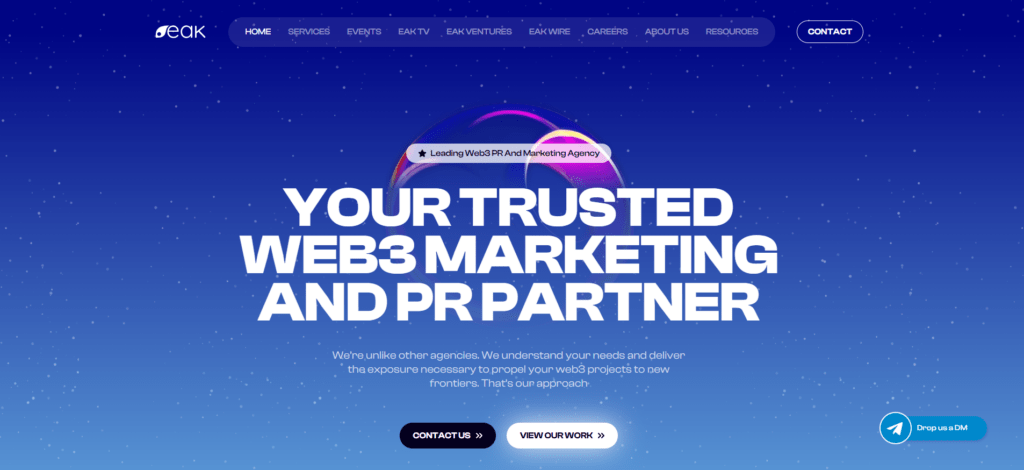
Eak Digital is a full-service ai marketing agency built specifically for the Web3 and blockchain ecosystem. Founded in 2017 and headquartered in London with offices in Los Angeles, Tokyo, Seoul, Dubai, Buenos Aires, and Istanbul, Eak Digital operates genuinely global AI marketing infrastructure for projects that require crypto-native audience intelligence alongside conventional digital marketing capability.
Core AI capabilities: On-chain audience modelling, real-time community sentiment monitoring, AI-driven KOL selection and attribution, automated press distribution via Eakwire, predictive community health metrics.
Pricing: Retainer and project-based models tailored to project stage and campaign scope.
2. Clickstrike — Best for AI and SaaS Companies
Clickstrike is the agency on this list built exclusively for AI and SaaS companies — a narrow enough specialisation to have generated genuine expertise in the specific dynamics of marketing AI products to technical buyers. The firm has secured 8,250+ media placements in outlets including TechCrunch, VentureBeat, Forbes, and MIT Technology Review, and maintains a vetted network of 500+ tech creators.
Core AI capabilities: AI-specific PR and earned media, AEO (Answer Engine Optimisation), AI buyer audience targeting segments, influencer attribution for technical audiences.
Pricing: Custom quote based on scope.
3. Wpromote — Best for E-Commerce and DTC Brands
Wpromote operates its proprietary Polaris platform — a machine learning system built for cross-channel campaign management across Google, Meta, and programmatic networks. Polaris models audience intent continuously, automates bid strategies, and generates predictive revenue forecasting that gives clients forward-looking visibility into campaign performance rather than purely historical reporting.
Core AI capabilities: Polaris platform (proprietary), predictive CLV modelling, automated creative testing and rotation, cross-channel attribution modelling, demand forecasting.
Pricing: Percentage of media spend plus retainer. Typically suited to businesses with $50,000+ monthly media spend.
4. Jellyfish — Best for Global Enterprise Marketing Transformation
Jellyfish operates at genuine enterprise scale — with Google, Uber, and Samsung among its clients — focused on AI-driven marketing transformation at the organisational level rather than the individual campaign level. The firm’s positioning recognises that for large enterprises, the challenge is not finding an AI tool but restructuring how a large, complex marketing organisation makes decisions around AI infrastructure.
Core AI capabilities: Enterprise AI transformation consulting, automated creative production at enterprise scale, multi-market attribution, AI-driven media planning.
Pricing: Enterprise-tier.
5. NoGood — Best for Growth-Stage B2B and B2C Brands
NoGood is a growth marketing agency that has built AI experimentation capability into its core methodology — running continuous full-funnel tests across paid, organic, product, and CRM channels simultaneously, using AI to identify which experiments are reaching statistical significance and should be scaled versus which should be cut.
For growth-stage companies where the cost of slow optimisation is high — where a 30-day experiment cycle versus a 7-day AI-accelerated cycle can mean the difference between scaling a working channel before a competitor does or missing the window — NoGood’s experimentation velocity is a meaningful differentiator. Performance-linked pricing options align agency incentives with client growth outcomes more directly than pure retainer structures.
Core AI capabilities: Full-funnel AI experimentation, rapid A/B and multivariate testing automation, cross-channel attribution, conversion rate optimisation.
Pricing: Performance-linked options available.
6. Single Grain — Best for SaaS, E-Commerce, and Crypto Brands
Single Grain is a growth-focused digital marketing agency with documented capability across AI-driven SEO, paid media, and content marketing for SaaS, e-commerce, and — notably for this context — crypto and Web3 brands. The firm has worked with Amazon, Uber, and Lyft on performance campaigns, and maintains specific capability in crypto marketing that makes it relevant to blockchain projects looking for an alternative to pure-play Web3 agencies.
AI in Single Grain’s workflow covers content strategy (AI-driven topic clustering and gap analysis), paid media management (automated bid optimisation across Google and Meta), and SEO (large-scale keyword intent modelling). The firm’s content marketing capability is particularly strong — combining AI-driven research and production efficiency with editorial standards that maintain the authority signals that Google rewards.
Core AI capabilities: AI-driven SEO and content strategy, paid media automation, conversion rate optimisation, crypto-specific paid media navigation.
Pricing: Retainer-based.
7. Tinuiti — Best for Retail and CPG Brands
Tinuiti is the specialist choice for retail and consumer packaged goods brands navigating the specific complexity of multi-retailer digital environments. The firm’s Bliss Point Media Mix Modelling technology uses machine learning to identify optimal budget allocation across Amazon, Google, and Meta simultaneously — minimising wasted cross-channel spend and maximising reach at the right frequency.
The Bliss Point platform is a genuine proprietary AI capability rather than a white-labelled third-party tool — giving Tinuiti’s clients a media mix modelling sophistication that was previously available only to brands with large in-house data science teams. AI-driven influencer analytics capability evaluates creator performance and conversion attribution at the granularity required to justify creator marketing investment at scale.
Core AI capabilities: Bliss Point MMM (proprietary), Amazon AI optimisation, cross-channel frequency management, AI-driven influencer performance analytics.
Pricing: Percentage of media spend plus retainer.
8. Seer Interactive — Best for B2B Brands Prioritising Search
Seer Interactive has built distinctive AI capability at the intersection of organic and paid search — identifying demand signals before they fully surface in standard keyword tools, and using integrated SEO and PPC data infrastructure to inform both channels with signals from the other.
The practical advantage is earlier positioning in competitive search landscapes — capturing audience intent before competitive CPCs reflect full market demand, and building organic content authority in topics before they reach peak competitiveness. For B2B technology companies where search is a primary acquisition channel and content authority is a long-term competitive moat, this integrated, data-forward approach compounds over time in ways that siloed SEO and PPC management cannot.
Core AI capabilities: Intent modelling and keyword clustering at scale, integrated SEO/PPC data infrastructure, AI-driven bid management, competitive demand forecasting.
Pricing: Retainer-based.
How to Choose the Right AI Agency for Your Business
The right AI marketing agency is determined by matching your specific business profile to the agency’s strongest AI capability — not by choosing the most well-known name or the highest-rated agency in a generic list.
| Business Profile | Recommended Agency | Key Reason |
| Web3, blockchain, crypto, DeFi, NFT project | Eak Digital | On-chain audience intelligence unavailable elsewhere |
| AI or SaaS company targeting technical buyers | Clickstrike | AI-specific PR relationships and AEO capability |
| E-commerce or DTC brand on Google and Meta | Wpromote | Predictive CLV and Polaris platform |
| Global enterprise needing AI transformation | Jellyfish | Organisational-level AI integration expertise |
| Growth-stage brand needing rapid experimentation | NoGood | Full-funnel AI experimentation velocity |
| SaaS or crypto brand with SEO + paid focus | Single Grain | Cross-channel AI optimisation and crypto experience |
| Retail or CPG brand managing multiple retailers | Tinuiti | Bliss Point MMM for multi-retailer allocation |
| B2B brand where search is primary acquisition | Seer Interactive | Integrated SEO/PPC intent modelling |
Related Reading
- AI Digital Marketing Agency: 7 Top Choices for 2026
- Blockchain Marketing Firm: How Firms Promote Tokens, NFT Projects & Web3 Brands
- NFT Marketing Agency: How Agencies Scale NFT Brands, Artists & Collections
How AI Transforms Key Marketing Functions
Understanding the specific applications of AI across marketing disciplines helps evaluate whether an agency’s AI capabilities align with your needs.
AI in Paid Advertising
The transformation of paid advertising through AI represents one of the most measurable impacts:
Predictive Bid Management: Instead of manually adjusting bids based on yesterday’s performance, AI systems predict which auctions will convert and adjust bids before impressions are served. This forward-looking approach consistently outperforms reactive bid strategies.
Dynamic Creative Optimization: AI ad agencies generate hundreds of creative variations, test them across micro-segments, and automatically promote winners. What previously required weeks of A/B testing happens continuously in real-time.
Audience Discovery: Machine learning identifies high-value audience segments that human analysts miss. By analyzing conversion patterns across thousands of attributes, AI finds profitable micro-segments too specific for manual discovery.
Budget Allocation: Rather than distributing budgets evenly or based on historical performance, AI models predict future returns and allocate budgets to maximize total conversions. This dynamic allocation often delivers 20-40% efficiency improvements over static distribution.
AI in SEO and Content Marketing
Search engine optimization has fundamentally changed with AI:
Answer Engine Optimization (AEO): As consumers shift from traditional search to AI platforms like ChatGPT and Perplexity, content must be optimized for AI extraction. This means structured data, clear entity relationships, and authoritative citations that AI engines recognize.
Predictive Keyword Research: AI models identify emerging topics and keywords before they become competitive, giving early movers significant advantages. This predictive capability transforms SEO from reactive to proactive.
Content Generation and Optimization: AI doesn’t just write content—it analyzes what performs, identifies gaps in existing content, and generates briefs that combine human creativity with data-driven strategy.
Technical SEO Automation: AI systems continuously monitor technical health, identify issues, prioritize fixes based on impact, and in some cases, automatically implement corrections.
AI in Personalization and Customer Experience
Personalization at scale requires AI:
Behavioral Prediction: Machine learning models predict what content, offers, or products individual users want before they express intent, enabling proactive personalization.
Dynamic Content Generation: AI creates personalized emails, landing pages, and ad creative for thousands of micro-segments, delivering relevance impossible through manual segmentation.
Chatbots and Conversational AI: Advanced NLP powers chatbots that handle complex customer service, qualify leads, and guide prospects through buying journeys with human-like understanding.
Journey Orchestration: AI maps customer journeys, identifies optimal touchpoints, and triggers personalized interactions based on behavioral signals and predicted outcomes.
Real-World AI Marketing Use Cases
Theory means nothing without results. Here are specific examples of how AI marketing agencies deliver measurable impact:
Case Study: SaaS Customer Acquisition Optimization
A B2B SaaS company partnered with an ai based marketing agency to reduce customer acquisition costs for their enterprise product. The challenge was a long sales cycle involving multiple stakeholders and touchpoints.
AI Implementation:
- Predictive lead scoring using machine learning trained on 3+ years of customer data
- Automated content recommendations based on prospect behavior and stage
- Dynamic email campaigns that adapted based on engagement signals
- Attribution modeling that identified which touchpoints actually influenced deals
Results:
- 42% reduction in CAC over 6 months
- 28% increase in marketing qualified leads
- 35% improvement in lead-to-customer conversion rate
- Sales cycle reduced by an average of 18 days
The key was not any single AI tool, but the integrated system that connected data across platforms and optimized the entire funnel continuously.
Case Study: E-commerce Revenue Growth Through AI Personalization
A mid-size e-commerce brand implemented AI-driven personalization across their website, email, and paid advertising with a marketing ai company.
AI Implementation:
- Product recommendation engine based on browsing and purchase history
- Dynamic pricing optimization for promotional campaigns
- Personalized email content generated for individual customer segments
- Predictive inventory management influencing promotional strategies
Results:
- 67% increase in average order value
- 52% improvement in email conversion rates
- 31% reduction in cart abandonment
- 4.2x return on AI implementation investment within first year
The transformation came from AI understanding individual customer preferences at scale and delivering personalized experiences that generic segmentation could never achieve.
Case Study: Web3 Project Launch with AI-Optimized Campaigns
A DeFi protocol partnered with a crypto-specialized ai ad agency to launch their platform and acquire initial users in a highly competitive market.
AI Implementation:
- On-chain analysis to identify high-value DeFi users on competing platforms
- Automated content creation tailored to crypto community culture
- Compliance monitoring across restricted advertising platforms
- Predictive modeling to identify which features would drive adoption
Results:
- Achieved 15,000 wallet connections in first 30 days
- 43% lower acquisition cost compared to competitor benchmarks
- Zero platform account suspensions despite restrictive crypto policies
- 68% of acquired users remained active after 90 days
Success required both AI capabilities and deep Web3 expertise—generic AI tools would have generated non-compliant creative and missed the cultural nuances essential for crypto audiences.
The Future of AI in Marketing: What’s Coming in 2026 and Beyond
Understanding emerging trends helps choose agencies positioned for long-term partnership:
Answer Engine Optimization (AEO) Becomes Standard
As search behavior shifts from Google queries to AI conversations, brands must optimize for inclusion in AI-generated responses. Agencies investing in AEO infrastructure now will dominate this channel, while those focused exclusively on traditional SEO will struggle.
The shift is measurable: traditional organic search traffic is projected to decline 25% by late 2026 as consumers increasingly rely on ChatGPT, Perplexity, Claude, and Google’s AI Overviews for information discovery. Brands not present in these AI-generated answers will lose visibility to competitors who are.
Predictive Analytics Becomes Proactive Strategy
Current AI predicts what will happen. Next-generation AI prescribes what to do about it. We’re moving from “this campaign will likely underperform” to “here are three specific optimizations that will improve performance by X%.”
This evolution transforms agencies from reporting on performance to actively preventing problems and identifying opportunities before they become obvious. Brands partnering with agencies making this transition will gain significant competitive advantages.
Hyper-Personalization at Individual Level
Mass personalization currently segments audiences into hundreds of groups. Emerging AI enables true individual personalization—unique content, offers, and experiences for each prospect based on their specific behavior, preferences, and predicted needs.
This requires sophisticated data infrastructure and AI models, but early adopters report conversion improvements of 2-3x over segment-based personalization. Agencies building this capability now will set new performance standards.
AI-Generated Multi-Modal Content
Current AI excels at text. Emerging AI generates video, audio, and interactive content at scale. Agencies that master multi-modal AI content creation will deliver creative variety and testing velocity impossible through traditional production.
This doesn’t replace human creativity—it amplifies it. Creative directors will guide AI systems that produce hundreds of variations, with humans selecting and refining the best results rather than manually creating every asset.
Ethical AI and Transparency Requirements
As AI becomes ubiquitous, regulatory scrutiny increases. Agencies must demonstrate transparent AI practices, explainable decision-making, and ethical data usage. Early adoption of AI transparency standards will become competitive differentiators.
Expect increased emphasis on AI auditing, bias detection, and clear disclosure of AI usage in marketing materials. Agencies building these practices now will avoid future compliance issues.
Conclusion
The AI marketing agencies delivering measurable results in 2026 are those where AI operates at the decision layer — not just the production layer. Automation, predictive analytics, personalisation at scale, and AI-driven SEO are the four capabilities that separate genuine AI marketing capability from AI-washed positioning.
For Web3 and blockchain projects, Eak Digital stands alone in combining on-chain audience intelligence with global PR infrastructure and AI-driven campaign execution — a combination no generalist AI based marketing agency can replicate. For SaaS, e-commerce, retail, and B2B brands, the right match depends on channel mix, business scale, and the specific AI capabilities most relevant to your acquisition environment.
The decision that matters is not which agency uses AI — they all do. The decision that matters is which agency uses AI in ways that will actually improve your campaign performance, reduce your acquisition costs, and build compounding brand authority over time.
Frequently Asked Questions (FAQs)
What is an AI marketing agency?
An AI marketing agency uses artificial intelligence, machine learning, and automation as core operational capabilities—not just productivity tools. They deploy predictive analytics, automated optimization, and AI-driven insights to deliver results faster and more efficiently than traditional agencies.
How much do AI marketing agencies cost?
Pricing varies significantly based on scope and sophistication. Entry-level managed AI services typically range from $1,500-$5,000/month for basic automation and content generation. Full-service AI growth programs run $10,000-$50,000+/month depending on campaign complexity, data infrastructure requirements, and level of customization needed.
What’s the difference between AI marketing agencies and traditional digital marketing agencies?
Traditional agencies rely primarily on human analysis, manual optimization, and periodic campaign reviews. AI marketing agencies integrate machine learning that continuously analyzes data, predicts outcomes, and automates optimization in real-time. This results in faster optimization cycles, more precise targeting, and typically 20-40% better efficiency metrics.
Can small businesses benefit from AI marketing agencies?
Absolutely. While enterprise clients were early AI adopters, many AI marketing agencies now offer scalable services accessible to small and mid-size businesses. Entry-level AI automation for social content, email nurturing, and basic SEO optimization delivers value at $2,000-$5,000/month—often less than hiring a full-time marketing employee while providing AI capabilities small teams couldn’t build internally.
How do I know if an AI marketing agency is legitimate or just hyping AI?
Ask specific questions about their AI infrastructure, request case studies with measurable AI-attributed results, and evaluate whether they explain how AI and humans collaborate. Legitimate agencies can articulate their data pipelines, machine learning models, and specific AI applications. Agencies giving vague answers about “AI tools” or refusing to explain their methodology likely lack sophisticated AI capabilities.
What results can I expect from an AI marketing agency?
While results vary by industry and campaign objectives, clients working with legitimate AI marketing agencies typically see 20-40% improvements in efficiency metrics (cost per acquisition, conversion rates, click-through rates) within 3-6 months. AI excels at incremental optimization across many variables, compounding to significant overall improvements. Beware agencies promising specific percentage gains—legitimate agencies discuss probability and typical ranges, not guarantees.
Do AI marketing agencies replace the need for in-house marketing teams?
No. AI agencies complement in-house teams by providing specialized AI capabilities, advanced analytics infrastructure, and scalable execution. The most successful partnerships involve in-house teams handling brand strategy, product messaging, and stakeholder management while agencies provide AI-powered campaign execution, optimization, and technical expertise.
How long does it take to see results from AI marketing?
Initial efficiency improvements often appear within 30-60 days as AI models begin optimizing campaigns. Significant performance gains typically materialize within 3-6 months as AI systems accumulate data and refine predictions. Long-term strategic advantages compound over 12+ months as AI models become increasingly accurate with more training data.