

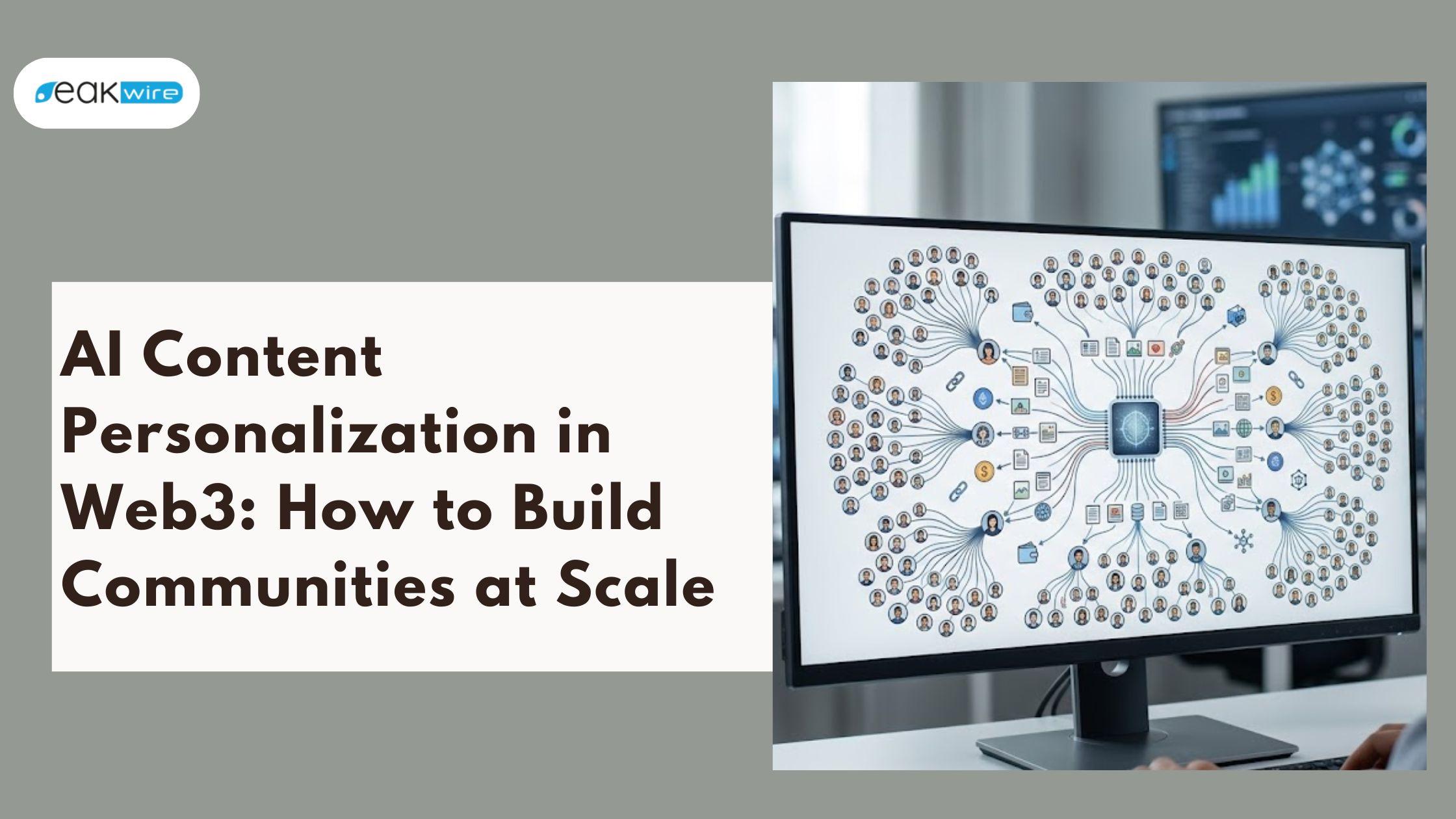
“AI content personalization is rewriting how Web3 projects communicate with token holders, NFT buyers, and DeFi users. This guide breaks down how to deploy it at scale without losing the community trust that makes crypto projects survive long-term.”
The average Web3 project speaks to three very different people at once: the seasoned DeFi yield farmer who understands liquidity pools in their sleep, the NFT collector chasing cultural clout and digital ownership, and the curious newcomer who just bought their first token on a centralized exchange.
Send all three the same Discord blast or email newsletter and you’ve already failed.
This is the core problem AI content personalization solves. Instead of broadcasting generic messaging and hoping it lands, AI-powered systems segment your audience by on-chain behaviour, engagement history, and wallet activity then deliver messaging tailored to where each user actually is in their journey.
For Web3 communities, this isn’t just a nice-to-have. It’s the difference between a community that grows and compounds and one that churns after the initial hype dies.
In this guide, we’ll explore how to use AI for content personalization in Web3 contexts, which segments to prioritise, what to automate, where human judgment remains essential, and how agencies like Eak Digital are helping projects execute this at scale without sacrificing authenticity.
What Is AI Content Personalization (and Why Web3 Is Different)?
AI content personalization is the practice of using machine learning and behavioural data to deliver tailored content, messaging, and experiences to specific users rather than pushing the same content to everyone.
In traditional marketing, this means Netflix recommending shows based on watch history or Spotify curating playlists based on listening habits.
In Web3, the data layer is fundamentally different and significantly richer.
Instead of cookies and login data, you’re working with:
- On-chain wallet activity — staking patterns, trading frequency, token holdings, governance votes
- NFT ownership history — collections held, mint participation, secondary market activity
- Cross-chain behaviour — which protocols a user interacts with across Ethereum, Solana, Base, Arbitrum, etc.
- Community engagement signals — Discord role, DAO voting history, forum participation
- Transaction timing and value thresholds — whale vs. retail, active vs. dormant
This pseudonymous but composable data makes content personalization AI in Web3 extraordinarily powerful. You can identify a dormant governance voter differently from a whale who just bridged assets — and serve each a message that speaks directly to their next likely action.
The Three Core Web3 Audience Segments (and How to Personalize for Each)
1. Token Holders
Token holders are your broadest segment ranging from long-term believers who haven’t sold a single token to speculative traders watching price charts every hour.
What they care about:
- Project roadmap and development updates
- Tokenomics, staking rewards, and utility expansion
- Governance proposals that affect their holdings
AI personalization in action: Use wallet age and holding duration to distinguish diamond hands from recent buyers. A holder who has been in since genesis deserves early access messaging and recognition. Someone who bought last week needs onboarding to your ecosystem, not advanced governance proposals.
AI personalized content examples:
- Early supporters → “You’ve been with us since Day 1. Here’s what’s coming exclusively for OGs.”
- Recent buyers → “Welcome to [Protocol]. Here’s everything you need to make the most of your tokens.”
- Dormant holders → Re-engagement flows triggered when wallets haven’t interacted in 60+ days
2. NFT Buyers and Collectors
NFT communities are often the most emotionally engaged and the most sensitive to inauthenticity. These users care about belonging, cultural identity, and the narrative around the collection they hold.
What they care about:
- Community drops, allowlists, and exclusive experiences
- The story and culture of the project
- Utility developments tied to their specific NFTs
AI personalization in action: Segment by collection held, rarity tier, and secondary market behaviour. A holder of a rare 1-of-1 has different expectations than someone who bulk-minted at launch. AI can identify these signals and tailor content accordingly.
AI personalized content examples:
- Rare holders → Exclusive sneak previews, direct outreach from the team, first access to collabs
- Floor buyers → Community events, utility updates, incentives to engage deeper
- Secondary market flippers → Re-engagement campaigns when trading volume picks up
3. DeFi Users
DeFi users are typically the most analytically sophisticated segment. They’re comparing APYs, reading smart contract audits, and tracking protocol TVL in real time. Generic marketing copy falls flat instantly.
What they care about:
- Yield opportunities and risk-adjusted returns
- Protocol security and audit history
- Liquidity incentives and farming rewards
AI personalization in action: Use on-chain data to understand which protocols a user already interacts with, their risk tolerance (based on assets held and strategies used), and their current yield-seeking activity. Speak their language with precision.
AI personalized content examples:
- Yield farmers → Real-time alerts on new pools, APY comparisons, liquidity mining opportunities
- Governance participants → Voting reminders, proposal summaries, delegate leaderboards
- Dormant liquidity providers → Re-engagement with updated incentives or new pool announcements
How AI for Content Personalization Works at Scale in Web3
Step 1: On-Chain Data Aggregation
The foundation of any AI content personalization system in Web3 is clean, structured on-chain data. Platforms like Nansen, Dune Analytics, and Formo allow teams to query wallet-level activity across protocols and chains. This data feeds into segmentation engines that cluster users by behaviour, not demographics.
Step 2: Audience Segmentation with Machine Learning
AI-powered segmentation tools analyse transaction patterns, holding behaviour, and community signals to create dynamic audience clusters. Unlike static email lists, these segments update automatically as user behaviour evolves so a dormant holder who suddenly starts staking moves into the right segment without manual intervention.
Step 3: Content Generation and Variant Testing
Once segments are defined, content personalization AI tools generate tailored copy variants for each group. This includes email subject lines, Discord announcements, push notifications, and landing page copy — each adapted to the segment’s language, sophistication level, and likely intent.
A/B testing runs automatically across variants, with AI optimising toward on-chain conversion signals (wallet connections, staking actions, governance votes) rather than vanity metrics like open rates.
Step 4: Multi-Channel Delivery
Personalized content is distributed across:
- Email and CRM platforms — tailored newsletters and onboarding sequences
- Discord and Telegram — role-based messaging, channel-specific announcements
- Wallet-native channels — direct wallet messaging via tools like Coinvise or XMTP
- Paid channels — retargeting ads served to specific wallet segments via platforms like Addressable
Step 5: Attribution and Feedback Loop
AI tracks the full journey from content interaction to on-chain action, creating a feedback loop that continuously refines personalization. Which content variant drove the most governance votes? Which re-engagement flow brought dormant holders back on-chain? These signals improve future campaigns automatically.
What to Automate vs. What Keeps Human Judgment
This is where most Web3 projects get it wrong. They either automate everything (and their community notices) or they personalize nothing (and their community disengages).
Here’s the practical framework:
Automate These
| Function | Why AI Handles It Better |
| Wallet segmentation | Processes millions of on-chain signals in real time |
| Behavioural trigger emails | Fires at the exact right moment without manual monitoring |
| A/B testing and variant selection | Optimises continuously without fatigue |
| Bot and fraud filtering | Identifies invalid wallets before they pollute segments |
| Performance analytics and attribution | Tracks on-chain conversion at a granularity humans can’t match |
Keep These Human
| Function | Why Human Judgment Matters |
| Brand voice and tone guidelines | AI optimises for engagement, not brand integrity |
| Community crisis responses | Sentiment-aware communication that builds trust |
| Strategic positioning decisions | Deciding who to target is a human strategic call |
| Governance and DAO communication | Political nuance requires cultural fluency |
| Influencer and partnership messaging | Relationship-driven, tone-sensitive outreach |
The most effective Web3 teams treat AI as a powerful execution layer — and keep humans in the loop for anything that touches community trust or brand identity.
Community Trust: The Non-Negotiable Variable
Crypto communities are uniquely sensitive to manipulation and inauthenticity. The same on-chain transparency that makes Web3 powerful also means your users can see when your token unlock schedule doesn’t match your “long-term vision” messaging. They can track wallet movements. They can identify when community outreach feels templated and hollow.
AI personalized content must feel human to work.
This means:
- Personalization signals should never feel surveillance-like — reference on-chain activity in ways that feel helpful, not invasive (“We noticed you’ve been staking — here’s what’s next for liquidity providers” vs. “We tracked your wallet and saw you unstaked on Tuesday”)
- Tone must match the community’s culture — a DAO of governance maximalists needs different language than an NFT project built around aesthetic and community vibes
- Frequency matters — AI-powered systems that trigger too many touchpoints will generate opt-outs and community backlash faster than any bear market
How Eak Digital Helps Web3 Projects Scale with AI Content Personalization
At Eak Digital, we combine on-chain data intelligence with content strategy built specifically for Web3 audiences.
Our approach to AI for content personalization in Web3 projects includes:
- Audience intelligence mapping — identifying your token holders, NFT buyers, and DeFi users as distinct segments with distinct needs, using on-chain data as the primary signal layer
- Content architecture design — building personalization frameworks that scale without losing voice or community trust
- Multi-channel personalization deployment — from email and Discord to wallet-native messaging and paid retargeting
- Performance tracking tied to on-chain outcomes — measuring what actually matters: staking actions, governance participation, wallet retention, and protocol TVL contribution
We work with Web3 projects that are serious about community — not just growth metrics.
Ready to build a personalization engine your community actually respects? Talk to the Eak Digital team →
Tools Powering AI Content Personalization in Web3 (2025–2026)
| Tool | Primary Use |
| Nansen | On-chain wallet analytics and segmentation |
| Dune Analytics | Custom on-chain data queries and dashboards |
| Formo | Web3-native form and audience data collection |
| Addressable | Wallet-based paid media targeting and retargeting |
| XMTP / Push Protocol | Decentralized wallet-to-wallet messaging |
| Coinvise | Token-gated community communication |
| HubSpot + Segment | CRM-side personalization with Web3 integrations |
Common Mistakes to Avoid
1. Segmenting by token balance alone: Wallet size is a blunt instrument. A large holder who’s never engaged with governance needs different content than a small holder who votes on every proposal. Behaviour beats balance.
2. Using the same tone across all channels: Discord and email require different voices. AI-generated content that ignores channel context feels off immediately to native Web3 users.
3. Ignoring the dormant segment: Many projects personalize for active users and forget that dormant wallets represent an enormous re-engagement opportunity especially around major protocol updates or token utility expansions.
4. Automating community crisis responses: When your protocol gets hacked, a bug is discovered, or a governance vote goes sideways this is not the moment for automated messaging. Human judgment, transparency, and speed are irreplaceable here.
5. Measuring personalization performance with Web2 metrics: Click-through rates and open rates don’t tell you if personalization is working in Web3. Measure on-chain actions: staking events, governance votes, wallet retention at 30/60/90 days.
What to Automate and What to Keep Human
The power of AI for content personalization in Web3 does not come without risk. Crypto communities have finely tuned radar for hollow outreach, and automated content that misjudges tone, makes incorrect assumptions from on-chain data, or generates copy without editorial oversight can erode the trust it was designed to build. The operational discipline is knowing exactly where automation creates value and where human judgment is non-negotiable.
| Function | Automate With AI | Keep Human |
| Wallet segmentation | AI-driven clustering from on-chain data | Strategic definition of segment criteria |
| Behavioural trigger detection | Automated wallet activity monitoring | Decision on which triggers warrant response |
| Content variant generation | AI drafting of personalised copy variants | Editorial review and brand voice enforcement |
| A/B testing and optimisation | Automated performance tracking and variant selection | Strategic interpretation of test results |
| Re-engagement sequences | Automated trigger-based delivery | Tone calibration for sensitive re-engagement |
| Crisis communications | Real-time sentiment monitoring and alert | All crisis messaging — always human-authored |
| Governance summaries | AI drafting from proposal data | Review for accuracy and neutrality |
| Community AMA responses | Never — always human | Always — authenticity is the entire value |
| Founder and team communications | Never — always human | Always — personal voice cannot be automated |
| Regulatory-sensitive messaging | Never — always human | Always — legal exposure risk is too high |
The clearest guideline is this: automate the data processing and content routing that AI executes faster and more accurately than humans. Keep human judgment on anything that shapes the community’s perception of the people behind the project. Web3 trust is built on the belief that there are real, accountable humans making real decisions on the other side of the protocol and no content personalization AI should compromise that perception.
Conclusion
AI content personalization in Web3 is not about replacing the human relationships that community trust depends on. It is about making those relationships operationally possible at a scale that no manual process can sustain.
A protocol with 50,000 token holders cannot have a human community manager personally assess the needs of every wallet and tailor communications accordingly. Content personalization AI does the data processing, the segmentation, and the content routing that makes relevant, timely, segment-specific communication possible across that audience freeing human team members to focus on the high-trust interactions that AI cannot and should not replace.
The Web3 projects that build the most durable communities in 2026 will be the ones that use AI personalized content to be more relevant at scale, while maintaining the authentic human voice that makes their project worth caring about in the first place.
Related Reading
- Crypto Community Management Services: Build a Loyal Web3 Audience in 2026
- NFT Marketing Agency: How Agencies Scale NFT Brands, Artists & Collections
- AI Digital Marketing Agency: 7 Top Choices for 2026
- Blockchain Marketing Firm: How Firms Promote Tokens, NFT Projects & Web3 Brands
FAQs: AI Content Personalization in Web3
Q: What is AI content personalization in Web3?
It’s the use of machine learning and on-chain behavioural data to deliver tailored content and messaging to different audience segments, token holders, NFT buyers, DeFi users based on their actual on-chain activity rather than generic demographics.
Q: How is Web3 personalization different from traditional personalization?
Traditional personalization uses cookies, login data, and purchase history. Web3 personalization uses wallet activity, on-chain transaction patterns, token holdings, and governance behaviour data that is pseudonymous, composable across protocols, and significantly richer in intent signals.
Q: Can AI personalization hurt community trust?
Yes, if done poorly. Messaging that feels surveillance-heavy, excessively automated, or misaligned with community culture will erode trust fast. The key is ensuring personalization feels helpful and contextually relevant, not invasive.
Q: What should be automated vs. kept human in Web3 personalization?
Automate audience segmentation, behavioural triggers, A/B testing, and performance analytics. Keep humans in control of brand voice, community crisis responses, strategic positioning, and relationship-driven outreach.
Q: How do I measure AI personalization success in Web3?
Track on-chain outcomes: governance participation rates, staking actions, wallet retention at 30/60/90-day intervals, and cost per transacting user not just email open rates or click-throughs.
Q: How does Eak Digital approach AI content personalization for Web3?
Eak Digital combines on-chain data intelligence with Web3-native content strategy to build personalization systems that scale without sacrificing community trust. We focus on on-chain outcomes, not vanity metrics.